
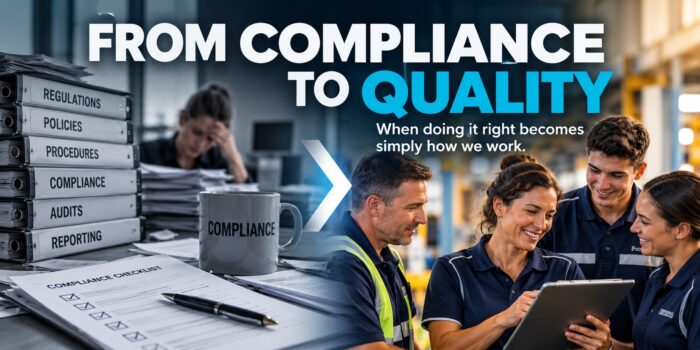
In heavily regulated businesses, compliance can easily become something employees feel is being imposed on them. But when regulatory requirements are integrated into everyday operations and supported by a strong quality culture, compliance can become part of simply doing the job properly.
There are policies to follow. Forms to complete. Records to maintain. Procedures to remember. Audits to prepare for. Managers remind people what they must do, while somebody in the organisation often becomes responsible for monitoring whether everyone else is complying.
The business may become compliant.
But it doesn’t necessarily develop a quality culture.
There is an important difference.
Compliance asks:
“What do we have to do?”
A quality culture asks:
“What does doing this properly look like?”
That change in perspective can have a profound effect on the way employees think about procedures, standards, accountability and even their own professionalism.
And, paradoxically, one of the most effective ways to achieve consistent compliance may be to stop treating compliance as a separate obligation and instead integrate its requirements into the normal way the business operates.
The Problem With a “We Must Comply” Culture
Regulatory requirements obviously matter.
In industries such as childcare, aviation, construction, healthcare, food production, logistics and other safety-critical environments, failure to comply can have serious consequences.
The problem isn’t compliance itself.
The problem occurs when compliance becomes a parallel management system sitting alongside the real operation of the business.
Employees perform their jobs, while policies, procedures, reporting requirements and regulatory obligations exist as an additional layer they must remember to satisfy.
This can create a familiar pattern:
Regulation → Compliance Responsibility → Guidelines → Staff Instructions → Monitoring
Management then spends considerable effort reminding people what needs to be done.
When regulations change, another guideline is circulated.
When somebody doesn’t follow the requirement, another reminder is issued.
When an audit approaches, attention to compliance increases.
The organisation may satisfy its obligations, but compliance remains something that feels external to the work itself.
That’s a fragile way to manage an important business responsibility.
Compliance Should Be Built Into the Way Work Happens
There is another approach.
Instead of asking:
“How do we make sure employees remember to comply with this requirement?”
ask:
“How should we design the operating process so that doing the job properly naturally satisfies this requirement?”
That is a fundamentally different management question.
Consider a regulatory requirement that an activity must be checked, recorded, authorised or communicated.
The weakest approach is to rely on employees remembering that there is a compliance obligation attached to the activity.
A stronger approach is to build the requirement into the operating process itself.
The workflow determines when the check occurs.
The role determines who is responsible.
The procedure explains how it is performed.
The appropriate record captures the evidence.
Training teaches the employee the correct standard.
Management measures whether the process is working.
The system is reviewed and improved when problems occur.
The relationship becomes:
Requirement → Process → Role → Procedure → Training → Measure → Review → Improvement
Compliance hasn’t disappeared.
It has become embedded in the way the business operates.
From “Following the Rules” to “Doing the Job Properly”
Embedding compliance into operating systems solves part of the problem.
The second part is cultural.
There is an enormous difference between an employee thinking:
“I have to do this because management says we have to comply.”
and:
“This is how we do the job properly here.”
The physical activity may be exactly the same.
The meaning attached to it is completely different.
The first mentality is externally imposed.
The second begins to become part of the employee’s professional standard.
This matters because management cannot supervise every action performed by every employee.
Eventually, the organisation depends upon people making appropriate decisions when nobody is standing beside them.
A strong quality culture helps establish the standard against which those decisions are made.
Instead of employees asking whether something is technically required, the question gradually becomes:
“Is this the standard of work we expect from ourselves?”
That’s a much more powerful foundation for consistent performance.
Quality and Professionalism Reinforce Each Other
This becomes particularly important in businesses where employees may not initially think of themselves as professionals.
Professionalism isn’t limited to accountants, engineers, doctors or executives.
A professional approach to work can exist at every level of an organisation.
It can mean:
- Following the correct process even when nobody is watching
- Understanding why standards exist
- Taking responsibility for the quality of your own work
- Identifying problems rather than working around them
- Keeping accurate records
- Communicating properly with colleagues and customers
- Learning from mistakes
- Developing competence
- Taking pride in producing a consistent result
When these behaviours become part of the identity of the workforce, compliance begins to look very different.
The employee isn’t merely satisfying a regulation.
They’re demonstrating what good work looks like.
That creates an opportunity for businesses to connect quality systems with something much more motivating than avoiding non-compliance:
professional pride and development.
A Real Example: Building Professionalism in a High-Risk Labour Environment
We have seen this cultural transition occur in practice.
The3rdGear worked with Elite Unpac, a business operating in the container unloading and logistics sector.
The nature of the work created an interesting management challenge.
The business employed many young and relatively inexperienced workers, often without extensive formal education, who nevertheless needed to operate within a high-risk environment requiring disciplined procedures and safe working practices.
It would have been easy to build the management approach around rules.
Do this. Don’t do that. Follow this procedure. Complete this form.
Instead, the implementation of The3rdGear’s Quality & Performance Assurance System — Q-PAS — became part of a broader shift in how the organisation thought about its work.
Quality, professionalism, correct processes and personal development became connected.
Employees weren’t simply being asked to comply.
They were being shown what it meant to become good at their job.
Standards became part of professional development.
Procedures became part of doing the work properly.
Competence became something employees could build.
Responsibility became something people could grow into.
Over time, that contributed to a very different organisational identity.
For a labour-intensive container unloading business, creating a culture centred on quality, professionalism and career development was a significant achievement.
The business subsequently became recognised as one of the stronger operators within its industry.
The lesson extends well beyond logistics.
The way management frames standards can influence the way employees perceive themselves and their work.
Quality Culture Doesn’t Mean Ignoring Compliance
Moving from a compliance culture to a quality culture does not mean becoming less rigorous about regulatory obligations.
Quite the opposite.
Regulatory requirements still need to be identified, understood, documented and verified.
Some obligations will require specific records, controls or evidence regardless of the organisation’s culture.
The difference is in how those requirements are operationalised.
A quality-focused organisation doesn’t say:
“We care about quality, so we don’t need to worry about compliance.”
It says:
“Compliance requirements define some of the minimum standards our operating system must reliably achieve. Our job is to build those standards into the way we work.”
That distinction is important.
Quality doesn’t replace compliance.
Quality provides a better organisational context in which compliance can occur consistently.
Why Relying on a “Compliance Person” Can Become a Weakness
Many growing businesses eventually appoint somebody to manage quality, safety, compliance or regulatory requirements.
That can be entirely appropriate.
The danger comes when the rest of the organisation unconsciously transfers responsibility to that person.
Compliance becomes:
“Sarah’s job.”
Sarah monitors the regulations.
Sarah updates the procedures.
Sarah reminds everyone what has changed.
Sarah prepares for the audit.
Sarah follows up missing records.
Sarah notices when something isn’t being done correctly.
The organisation may actually become dependent on Sarah for compliance.
That’s not a strong compliance system.
A specialist should provide expertise, oversight, coordination and assurance.
But operational compliance needs to live within the roles and processes where the work actually occurs.
Managers should own the performance of their areas.
Employees should understand the standards relevant to their work.
Processes should incorporate the required controls.
Training should develop the necessary competence.
Management systems should make exceptions visible.
In other words:
Compliance expertise can be centralised. Compliance responsibility cannot.
Quality Systems Should Make the Right Way the Easy Way
Poorly designed systems often make compliance harder than it needs to be.
Employees may have to remember separate procedures, duplicate information across several forms, search for documents, perform unnecessary administrative steps or work around processes that don’t reflect what actually happens operationally.
Eventually, shortcuts appear.
Management may interpret that as an employee attitude problem.
Sometimes it is.
But sometimes the system itself is encouraging non-compliance.
A well-designed quality system should aim to make the correct process the natural process.
That means asking practical questions:
- Can unnecessary steps be removed?
- Can required checks be incorporated into existing workflows?
- Can responsibilities be made clearer?
- Can forms or records be simplified?
- Can systems prevent common mistakes?
- Can training explain why the requirement matters?
- Can managers see exceptions without constantly policing people?
- Can employees suggest improvements when procedures don’t work?
The objective isn’t merely to document the theoretically correct way to operate.
It’s to create an operating system people can actually use consistently.
Compliance Can Become a Business Improvement Tool
There is another benefit to changing the perspective.
Regulatory requirements often force organisations to examine activities they might otherwise manage informally.
Processes have to be defined.
Responsibilities need to be allocated.
Records must be maintained.
Competence may need to be demonstrated.
Incidents need to be investigated.
Performance has to be reviewed.
Viewed purely through a compliance lens, these activities can feel like administrative burden.
Viewed through a business-performance lens, many of them are simply good management disciplines.
A documented process can improve consistency.
Clear responsibilities improve accountability.
Training improves competence.
Records create management visibility.
Incident analysis can identify systemic weaknesses.
Reviews can drive continuous improvement.
The question becomes less:
“How cheaply can we satisfy this requirement?”
and more:
“How can we use this requirement to make the business better?”
That is where compliance starts contributing to business performance rather than simply consuming resources.
What Does a Quality-Focused Compliance System Look Like?
An effective system usually brings several elements together.
Requirements are understood
The organisation knows which regulatory, contractual, customer and internal standards apply.
Requirements are translated into operations
Obligations are incorporated into processes rather than maintained as a separate list of things employees need to remember.
Responsibilities are clear
People understand which standards they are responsible for maintaining within their role.
Procedures reflect reality
Documentation describes an effective way to perform the work, rather than an idealised process nobody actually follows.
Training develops competence
Employees aren’t simply told the rule. They learn how to perform the activity correctly and understand why the standard matters.
Performance is visible
Management can identify whether processes are being followed and whether they are producing the required result. The right business performance measures also make exceptions and emerging problems visible before they become larger issues.
Problems drive improvement
Errors, incidents, complaints and non-conformances aren’t merely corrected. They are used to identify opportunities to improve the underlying system.
Management reinforces the standard
Leaders demonstrate through their own decisions that quality matters even when there is pressure to take shortcuts.
When these elements reinforce one another, quality begins to become part of the organisation’s culture.
The Quality Culture Management Is Really Trying to Create
Ultimately, the goal isn’t to have employees constantly thinking about compliance.
Nor is it to have them constantly thinking about the quality management system.
The goal is for the correct behaviours to become increasingly normal.
People know their responsibilities.
They understand the standard.
They have been trained properly.
The operating process supports them.
Managers reinforce expectations.
Problems are addressed rather than tolerated.
Improvement is encouraged.
Eventually:
“That’s the rule”
can become:
“That’s how we do things here.”
And ultimately:
“That’s what professional work looks like.”
That is a much deeper cultural achievement than simply passing an audit.
From Compliance Obligation to Business Performance System
At The3rdGear, this philosophy sits behind our approach to Q-PAS — the Quality & Performance Assurance System.
Rather than treating quality management as a documentation or certification exercise, Q-PAS is designed to integrate processes, responsibilities, standards, training, measurement and improvement into the operating system of the business.
That also explains why we see quality management as part of a broader Business Performance System.
Quality doesn’t exist independently of the rest of the organisation.
It affects productivity.
It affects customer experience.
It affects risk.
It affects employee development.
It affects accountability.
It affects profitability.
And, as we’ve seen in practice, it can affect the way employees perceive their own professionalism.
For regulated businesses in particular, there is an opportunity to stop seeing compliance purely as an obligation imposed from outside the organisation.
The better question may be:
How can we build a business where the way we naturally operate produces the quality, professionalism and compliance our customers, employees, regulators and management should expect?
When the system is designed properly, compliance becomes less about repeatedly reminding people what they must do.
It becomes an outcome of doing the job properly in the first place.
About The3rdGear
The3rdGear works with established Australian businesses to develop practical Business Performance Systems that integrate strategy, commercial performance, operations, leadership, accountability and management information.
The3rdGear’s Q-PAS methodology helps businesses integrate quality and performance requirements into everyday operations, with the objective of improving consistency, accountability, professionalism and business performance — rather than simply creating another layer of documentation.