
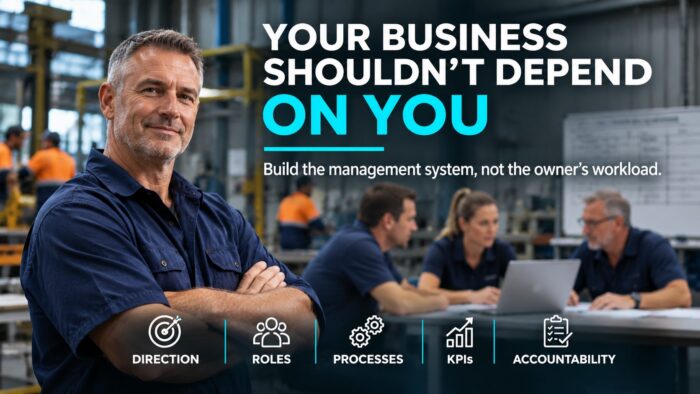
How to Build a Management System That Doesn’t Depend on the Business Owner
Many successful businesses eventually develop an owner dependency problem.
The business has employees. It may have supervisors or managers. Revenue has grown. Customers are being served and, from the outside, the organisation appears well established.
But behind the scenes, almost everything important still seems to come back to the owner.
Employees ask the owner what to do.
Managers escalate decisions.
Customer problems find their way to the owner.
Quality depends on the owner noticing when something isn’t right.
Priorities change according to what the owner is focused on.
Important knowledge remains in the owner’s head.
And when the owner steps away, decisions slow down and problems accumulate.
At this point, the business doesn’t simply have an owner dependency problem.
It has a management system problem.
The owner has effectively become the management system.
Solving that problem requires more than delegation. The business needs to replace its dependence on the owner’s personal involvement with a structured management system that provides direction, authority, accountability and control.
Done properly, the owner can become less involved in everyday operations without losing control of the business.
In fact, they can often gain more control.
What Does Owner Dependency Actually Look Like?
Owner dependency isn’t simply an owner working long hours.
Some business owners choose to remain heavily involved because they enjoy it.
The real problem occurs when the business cannot operate effectively without their involvement.
Typical signs include:
- Managers regularly seeking approval for routine decisions
- Employees bypassing managers and going directly to the owner
- Problems remaining unresolved until the owner intervenes
- Important customer relationships depending personally on the owner
- Processes being understood through experience rather than documented clearly
- Staff being unsure who has authority to make particular decisions
- Performance problems being identified through the owner’s observations rather than reliable management information
- Managers having responsibility without sufficient authority
- Meetings generating discussion but inconsistent follow-through
- Business performance declining noticeably whenever the owner is absent
The owner often becomes the organisation’s central source of knowledge, decision-making, coordination and accountability.
That may work surprisingly well when the business is small.
It becomes increasingly difficult as the organisation grows.
Why Owner Dependency Develops
Most owner-dependent businesses weren’t deliberately designed that way.
The dependency develops naturally.
In the early stages of a business, the owner often does almost everything.
They win customers, quote work, solve problems, make purchasing decisions, recruit employees, check quality and manage cash.
As employees are added, tasks are delegated.
But the management system often isn’t.
The owner continues making important decisions, monitoring standards, setting priorities and holding the organisation together.
Eventually the business may have 10, 20, 50 or more employees, yet many of the management mechanisms still resemble those of the much smaller company it used to be.
This creates an important distinction:
A business can grow operationally without growing managerially.
Revenue, employees, customers and workload increase.
But management structure, processes, reporting, accountability and decision-making disciplines fail to develop at the same rate.
Eventually the owner’s personal capacity becomes one of the constraints on further growth.
Why Delegation Alone Doesn’t Solve Owner Dependency
The obvious solution appears to be delegation.
The owner needs to “let go”.
Sometimes that’s true.
But delegation only works effectively when the person receiving responsibility operates within a structure that allows them to succeed.
Imagine telling a manager:
“I want you to take responsibility for operations.”
What exactly does that mean?
Which results are they responsible for?
What decisions can they make independently?
Which decisions still require approval?
What standards must operations achieve?
Which processes should be followed?
How will performance be measured?
What information should they report?
When should they escalate a problem?
How will their performance be reviewed?
If those questions haven’t been answered, the owner hasn’t really delegated management.
They’ve transferred responsibility without building the management infrastructure required to support it.
The predictable result is that the manager keeps returning to the owner for direction.
The owner then concludes:
“Nobody takes ownership unless I stay involved.”
Sometimes the real problem isn’t the manager’s willingness to take responsibility.
The business hasn’t created a system within which they can confidently exercise it.
Hiring Managers Isn’t the Same as Building Management
This explains why hiring a manager doesn’t automatically make a business less owner-dependent.
A new manager may be capable, experienced and motivated.
But if they enter an organisation where responsibilities are unclear, processes live in people’s heads, authority is ambiguous, performance measures are weak and management meetings are inconsistent, they have little choice but to rely on the owner.
They need to understand how the owner wants things done.
So they ask.
They need to know whether they can approve something.
So they ask.
They need to understand whether performance is acceptable.
So they ask.
Before long, the owner has a manager but still makes most of the important decisions.
The organisation has added a management position without necessarily adding management capability.
Building management capability requires a system.
What Does an Owner-Independent Management System Need?
There isn’t one management structure that suits every business.
A 12-person trade services company shouldn’t be managed like a 150-person manufacturer.
But an effective management system generally needs several elements working together.
1. Clear Direction
Managers cannot make good independent decisions if they don’t understand what the business is trying to achieve.
They need clarity around:
- Business priorities
- Strategic objectives
- Commercial expectations
- Customer proposition
- Operational standards
- Important constraints
- Current improvement priorities
Without clear direction, delegation can produce activity without alignment.
Managers make reasonable decisions based on their own understanding, but those decisions may not support where the owner wants the business to go.
Strategic clarity creates the boundaries within which independent management decisions can occur.
2. Clear Roles and Responsibilities
One of the biggest sources of owner dependency is ambiguity.
When nobody is certain who owns an issue, it often ends up with the owner.
A functioning management structure should make clear:
- Who is responsible for each major area of the business
- What outcomes each role is expected to produce
- Where responsibilities begin and end
- How roles interact
- Which responsibilities are shared
- Who has authority to make particular decisions
This doesn’t require enormous job descriptions filled with administrative detail.
It requires clarity of accountability.
The question should be answerable:
“Who owns this?”
If the answer is routinely the business owner, the management structure still has work to do.
3. Defined Decision-Making Authority
Responsibility without authority creates dependency.
If managers are responsible for producing results but need owner approval for every meaningful decision, they aren’t really managing.
At the same time, simply telling managers they can “make decisions” is too vague.
Effective delegation establishes boundaries.
For example:
A manager may have authority to approve expenditure up to an agreed amount.
They may recruit within an approved workforce plan.
They may resolve customer issues within defined commercial limits.
They may adjust operational resources while remaining within budget and service standards.
They may implement improvements provided they don’t create specified financial, safety or strategic risks.
The precise boundaries vary enormously between businesses.
What matters is that people understand them.
Clear authority allows decisions to move away from the owner without creating uncontrolled risk.
4. Documented Processes and Operating Standards
Owners frequently underestimate how much operational knowledge they carry in their heads.
They know which supplier to call.
They know when a job doesn’t look right.
They know which customers require special handling.
They know how margins should behave.
They know which shortcuts create problems.
They know when something feels wrong.
That accumulated knowledge can make an experienced owner extraordinarily effective.
It can also make the organisation extraordinarily dependent on them.
Processes, procedures, standards and training allow important organisational knowledge to move from individual memory into the business itself.
The objective isn’t to document every movement employees make.
It is to identify the processes where consistency, quality, risk, efficiency or knowledge transfer matter.
A good operating system gives employees and managers a reliable way to perform the work without continually asking:
“How would the owner do this?”
5. Meaningful Performance Measures
Owners often retain control through observation.
They walk through the business.
They talk to employees.
They inspect jobs.
They watch the bank account.
They know which customers are unhappy.
They sense when sales have slowed.
This informal management style can be highly effective in a small organisation because the owner is close to everything.
It becomes unreliable as the business grows.
Management needs a more scalable way of understanding performance.
That means identifying the relatively small number of measures that show whether each important part of the business is performing as expected.
These might include:
- Revenue and margin
- Sales pipeline and conversion
- Labour productivity
- Utilisation
- Job profitability
- On-time delivery
- Quality or rework
- Customer service measures
- Cash and debtor performance
- Role-specific KPIs
- Strategic milestones
The objective isn’t more reporting.
It’s management visibility.
A well-designed Business Performance Dashboard can allow the owner and management team to see where performance is on target, where it isn’t and where management attention is required.
That begins replacing control through personal involvement with control through information.
6. Accountability for Results
Measurement without accountability achieves very little.
Every important area of performance should ultimately have somebody responsible for managing it.
That doesn’t mean blaming a manager whenever a number moves in the wrong direction.
Accountability means the manager is expected to:
Understand the result.
Investigate significant variance.
Identify causes.
Develop appropriate actions.
Implement those actions.
Report progress.
Ask for help when necessary.
This is very different from the owner seeing a poor result and personally taking over the problem.
A mature management system allows the owner to ask:
“What are you doing about it?”
rather than:
“What do I need to do about it?”
That is a significant shift.
7. A Consistent Management Rhythm
Management shouldn’t only happen when something goes wrong.
A functioning management system needs a rhythm.
Depending on the organisation, that might include:
- Short operational meetings
- Weekly management meetings
- Monthly performance reviews
- Quarterly strategic reviews
- Individual manager reviews
- Project or departmental meetings
The frequency matters less than the discipline.
The purpose is to create regular opportunities to review performance, identify exceptions, make decisions, assign actions and follow through.
A strong management rhythm prevents the owner from becoming the mechanism that constantly reminds everyone what needs attention.
The system itself creates the follow-up.
8. Reliable Management Information
One of the reasons owners struggle to step away is fear.
“If I’m not there, how will I know what’s happening?”
That’s a reasonable concern.
Reducing owner involvement should never mean reducing owner visibility.
The solution is not blind trust.
It’s better management information.
The owner should be able to understand:
- How the business is performing
- Where significant problems exist
- Whether managers are addressing them
- Whether strategic priorities are progressing
- Whether commercial performance is on track
- Whether important risks require attention
This creates an important principle:
Owner independence should reduce operational involvement, not management visibility.
The owner doesn’t need to know every detail.
They need confidence that the management system will make the important details visible.
The Difference Between Control and Involvement
This is where many owners become stuck.
They associate control with personal involvement.
If they aren’t approving the decision, checking the job or solving the problem, they feel they are losing control.
But involvement and control aren’t the same thing.
An owner who personally solves every operational problem may be extremely involved while having relatively poor systemic control.
Problems still depend on them being present.
A stronger management system creates control through:
Clear expectations → Defined authority → Processes → Measures → Accountability → Reporting → Management review
That means the owner can actually become less involved and more informed.
Instead of controlling individual activities, they increasingly control the system through which those activities are managed.
The Owner’s Role Has to Change Too
Building an owner-independent management system isn’t only about changing employees and managers.
The owner’s behaviour also needs to change.
If managers are given authority but the owner routinely overrides their decisions, employees quickly learn where the real authority sits.
If employees bypass their manager and the owner solves the problem anyway, the organisation learns that escalation works.
If a manager is accountable for a result but the owner continually steps in and manages it personally, accountability becomes blurred.
Owners therefore need to become disciplined about where they intervene.
That doesn’t mean refusing to help.
It means asking different questions.
Instead of:
“I’ll sort it out.”
Try:
“Who is responsible for this?”
Instead of:
“Here’s what you need to do.”
Try:
“What do you think we should do?”
Instead of immediately solving the problem:
“What does our process say?”
And when something repeatedly requires owner intervention:
“What is missing from our management system that keeps allowing this to come back to me?”
That final question is particularly powerful.
Repeated owner involvement is often a symptom.
The objective is to identify the underlying system weakness.
Owner Dependency Doesn’t Disappear Overnight
Businesses that have relied heavily on their owner for many years won’t become independent because new role descriptions are issued on Monday.
Management capability needs to be built.
Managers need time to develop judgement.
Processes need to be tested.
Performance measures need refinement.
Authority needs to be transferred progressively.
Management meetings need to develop discipline.
Employees need to learn new escalation pathways.
And owners need to become comfortable allowing other people to make decisions differently from how they might have made them themselves.
Some mistakes will occur.
That doesn’t necessarily mean delegation has failed.
The objective isn’t to create a business where nobody ever makes a poor decision.
It’s to create a system that can identify problems, learn from them and improve without requiring the owner to personally control everything.
When Does Owner Dependency Become a Serious Business Problem?
Owner dependency becomes particularly important when it begins limiting what the business or owner can do next.
Warning signs include:
- Growth is increasing the owner’s workload rather than reducing it
- Managers exist but major decisions still flow through the owner
- The business struggles when the owner takes leave
- The owner cannot focus on strategy because operational issues dominate their time
- New locations, teams or divisions would create too much additional management complexity
- Performance information isn’t reliable enough for the owner to step back
- Staff accountability depends on the owner’s personal follow-up
- The owner wants succession, investment or eventual sale but the business remains dependent on them
- The owner’s knowledge is difficult to transfer
- The owner feels they cannot trust the business to operate properly without them
At this point, telling the owner simply to “delegate more” is unlikely to solve the underlying problem.
The organisation needs management infrastructure capable of carrying responsibilities that previously sat with the owner.
From Owner-Dependent Business to Management-Driven Business
The ultimate objective isn’t to remove the owner from the business.
It’s to change the role the owner plays.
Instead of being the central point through which everyday business activity flows, the owner can increasingly focus on:
- Direction
- Strategy
- Major commercial decisions
- Leadership
- Management development
- Investment
- Innovation
- Key relationships
- Future opportunities
Meanwhile, everyday business performance is supported by an integrated management system.
The transition looks something like this:
Owner knowledge → Organisational processes
Owner decisions → Defined management authority
Owner supervision → Performance measures
Owner follow-up → Management accountability
Owner problem-solving → Management capability
Owner visibility through involvement → Visibility through management information
That’s what reducing owner dependency really means.
It isn’t simply about the owner working fewer hours.
It’s about building a business with enough management capability and structure to perform without depending on the owner’s constant intervention.
A Management System Should Give the Owner Freedom Without Losing Control
At The3rdGear, this is one of the central ideas behind our approach to Business Performance Systems.
Strategy, commercial performance, processes, leadership, accountability and management information shouldn’t operate as separate management initiatives.
They need to work together.
When they do, the business becomes less dependent on individual people — including the owner.
Managers know what they’re responsible for.
Employees understand how work should be performed.
Performance becomes visible.
Problems have owners.
Actions are followed through.
Management meetings have purpose.
And the owner no longer needs to personally hold all of those elements together.
That’s the real transition:
The owner stops being the management system because the business finally has one.
For an established business, that can create something even more valuable than growth.
It creates the ability to grow, improve and operate without requiring the owner to grow their personal workload with it.
About The3rdGear
The3rdGear works with established Australian SMEs to develop practical Business Performance Systems that integrate strategy, commercial performance, operations, leadership, accountability and management information.
Our approach is designed to help businesses develop the management structure and systems needed to improve performance, reduce unnecessary owner dependency and create greater visibility and control as the organisation grows.