
What Serious Business Advisors Need Beyond Experience
Many business advisors build their careers around experience, but far fewer operate within structured advisory systems designed to deliver consistent business improvement outcomes. Over time, experience becomes valuable. It improves judgement, strengthens pattern recognition, and helps advisors guide business owners through increasingly complex situations.
However, experience alone rarely creates consistent business improvement.
At a certain level, advisors need more than experience.
They need structure.
The Limits of Experience-Based Advisory Work
Experience is important.
But experience alone can create limitations within consulting engagements.
In many cases:
- approaches vary between clients
- decision-making becomes heavily intuition-based
- implementation lacks consistency
- operational improvement becomes difficult to measure
This is one of the reasons many advisory relationships struggle to produce repeatable outcomes over time.
Without structure, even highly capable advisors can find themselves rebuilding elements of their approach for each new client engagement.
Why Serious Advisors Begin Building Systems
As advisors gain experience, many begin recognising the need for more structured methodologies.
They start introducing:
- diagnostic frameworks
- performance measurement systems
- strategic planning models
- operational accountability structures
- implementation and follow-up processes
Over time, these elements evolve into something larger:
An advisory system.
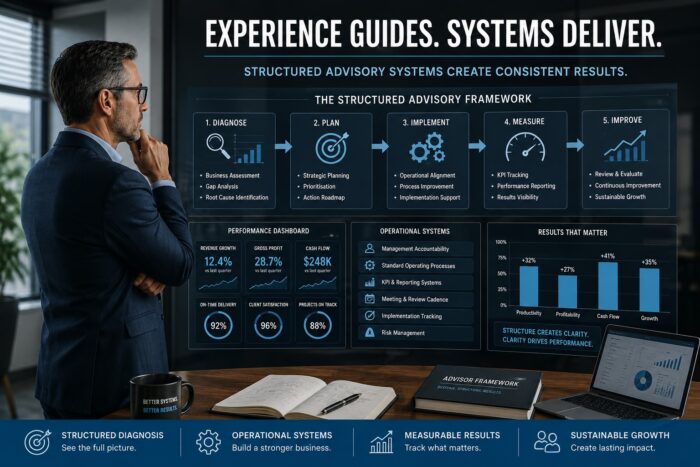
Not just individual tools or templates, but a structured framework for diagnosing, managing, and improving business performance consistently.
This transition often marks the difference between experience-based consulting and system-based advisory work.
What Structured Advisory Systems Do Differently
System-based advisors typically operate with greater consistency and operational clarity.
Rather than relying primarily on conversation or intuition, they work through defined frameworks that help guide both diagnosis and implementation.
This often includes:
- structured business diagnostics
- KPI and reporting systems
- operational review processes
- strategic planning frameworks
- accountability systems
- implementation tracking
These elements are commonly associated with structured management disciplines such as management systems, but are rarely integrated into a cohesive advisory framework within small business consulting.
The result is a more structured and measurable consulting model.
One that allows advisors to:
- deliver more consistent outcomes
- improve engagement clarity
- measure operational progress more effectively
- create higher-value advisory relationships
The Gap Most Advisors Never Fully Close
Most advisors recognise the importance of structure.
Far fewer successfully build a complete advisory system.
Not because they lack capability — but because integrating diagnostics, performance tracking, planning, accountability, and implementation into a single operational model is a multi-year process.
Most consultants accumulate pieces of a system over time.
Very few fully integrate them.
This is why many advisory businesses remain heavily dependent on the individual consultant rather than a structured consulting methodology.
The Value of Structured Advisory Systems
At a certain point, many experienced advisors begin moving beyond purely experience-based consulting and toward more measurable forms of operational consulting.
They start looking for:
- greater consistency
- more measurable outcomes
- scalable engagement structures
- clearer operational frameworks
This is where structured advisory systems become increasingly valuable.
They provide:
- consistency across engagements
- operational visibility
- measurable performance frameworks
- structured implementation pathways
- repeatable consulting methodology
For many advisors, this shift represents a significant evolution in how they deliver business improvement services.
A Different Way to Operate
Some advisors spend years developing their own systems through experience, experimentation, and refinement.
Others choose to incorporate an established advisory framework that has already been developed through real-world consulting work.
This allows them to operate with greater structure and operational depth without needing to build an entire system from scratch.
Exploring Structured Advisory Systems
For advisors seeking to move beyond purely experience-based consulting, structured systems offer a more integrated way to deliver business improvement.
They provide:
- structured diagnostics
- operational performance visibility
- management accountability systems
- implementation frameworks
- consistent advisory methodology
If you’re interested in how experienced advisors incorporate structured systems into their consulting practice: